


AI Is Already in Your Business – Is It Secure?
28 January 2026

Artificial Intelligence is no longer an emerging technology. It’s already embedded across modern organisations – driving productivity, accelerating decision-making, and reshaping how work gets done.
But there’s a growing disconnect.
While AI adoption is accelerating at pace, governance, security, and visibility are lagging behind. In many businesses, AI tools are being used daily without formal approval, oversight, or alignment to cyber security frameworks.
This creates a new and urgent challenge:
How do organisations unlock the value of AI without introducing unacceptable risk?
The Rise of “Shadow AI” in Modern Organisations
Much like shadow IT in previous decades, Shadow AI refers to AI tools being adopted organically by employees — outside of sanctioned platforms or security controls.
Common examples include:
- Public generative AI tools used to analyse internal data
- AI assistants embedded in browsers, CRMs, or SaaS platforms
- Automated decision tools influencing operations without governance review
While well-intentioned, this behaviour can quietly expose organisations to:
- Data leakage and IP loss
- Regulatory and compliance breaches
- Loss of control over sensitive customer or commercial information
AI doesn’t need malicious intent to create risk, lack of oversight is enough.
Why AI Is Now a Cyber Security Issue
Traditionally, AI has been treated as an innovation or productivity initiative. That mindset is outdated.
Today, AI intersects directly with:
- Data security
- Identity and access management
- Privacy obligations
- Threat detection and response
At the same time, threat actors are actively using AI to:
- Automate phishing campaigns
- Create highly convincing deepfakes
- Scale reconnaissance and attack execution
This creates an asymmetric risk: attackers are moving faster with AI than many organisations are defending against it.
As a result, AI strategy and cyber security strategy can no longer operate in silos.
The Organisations That Win with AI Think Differently
The most successful organisations are not banning AI — nor are they adopting it blindly.
They are taking a disciplined, governance-led approach that balances innovation with control.
This typically includes:
- Clear AI usage policies aligned to risk appetite
- Visibility into which tools are being used and where data is flowing
- Integration of AI into existing cyber security frameworks
- Executive and board-level accountability for AI risk
In other words, they govern AI with the same rigour they apply to cloud, data, and security.
Key AI Risks Leaders Are Commonly Missing
Despite growing awareness, many leadership teams still underestimate the scope of AI-related risk.
Here are some of the most common blind spots:
1. Data Exposure Through AI Prompts
Sensitive information entered into AI tools may be stored, reused, or exposed outside your organisation.
2. Unclear Ownership and Accountability
Without defined governance, no one is accountable for how AI is used, until something goes wrong.
3. Compliance and Regulatory Gaps
AI use can inadvertently breach privacy, data sovereignty, or industry regulations.
4. AI-Driven Threat Evolution
Security controls designed for human-scale attacks may struggle to detect AI-enabled threats.
From Risk to Competitive Advantage
When governed properly, AI becomes more than a productivity tool — it becomes a strategic advantage.
Organisations that integrate AI securely benefit from:
- Faster, safer decision-making
- Increased operational efficiency
- Stronger customer trust
- Reduced likelihood of costly incidents
Security and governance don’t slow innovation — they enable it at scale.
How Virtuelle Helps Organisations Govern AI Safely
At Virtuelle Group, we work with organisations to align AI adoption with cyber security, risk management, and business outcomes.
Our approach focuses on:
- Assessing current AI usage and exposure
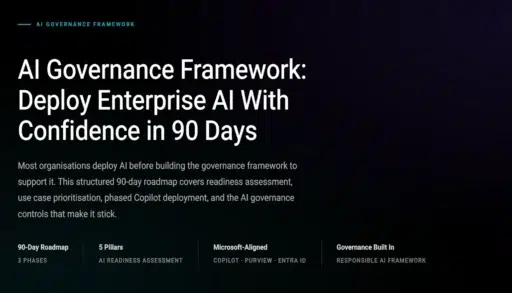
- Establishing AI governance frameworks
- Embedding AI into existing cyber security controls
- Supporting leadership teams with clarity, not complexity
We help businesses move forward with confidence, not fear.
AI is already inside your organisation.
The only question is whether it’s visible, governed, and secure.
If you’re unsure how AI is being used or how it fits into your cyber strategy, now is the time to act.